
Immunity to Change (ITC)
ITC is the change engine
The Leadership Circle Profile shows what pattern a leader runs and the Subject-Object Interview shows how they make meaning, while ITC is how a specific stuck change actually moves. With teams it pairs with BRITE, which locates where a team's energy leaks; ITC often explains why the leak persists.
What it is
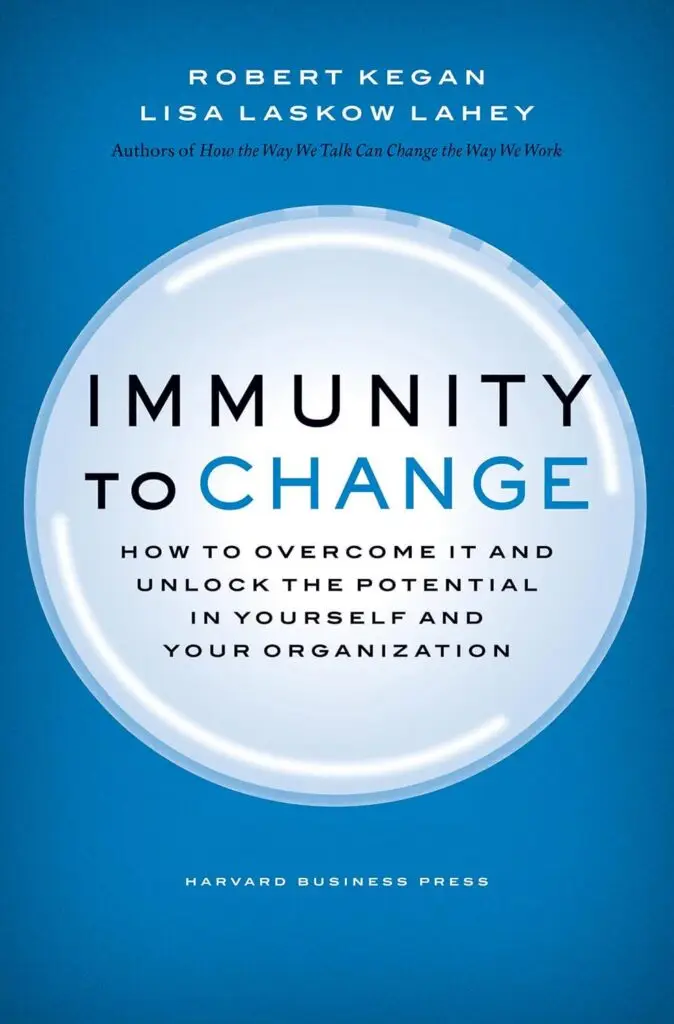
Immunity to Change is a structured diagnostic process developed by Kegan and Lahey and described in their book of the same name (Harvard Business Press, 2009). It lays a stuck change out in four columns: the improvement goal; an honest inventory of what you do and don't do that works against it; the hidden competing commitments those behaviours serve; and the big assumptions that make the competing commitments feel necessary. The big assumptions are the target. A person rarely knows they hold them; they operate as the lens the person sees through. That is also why willpower alone never dislodges them.
Whether ITC is the right tool comes down to a distinction from the same body of work. Technical challenges yield to new skills and information. Adaptive challenges require a change in how the person makes sense of things, and ITC was built for those alone.
How it works
For an individual, the process starts with a structured mapping session of 1.5 to 2 hours, usually inside a broader coaching engagement. Building the map is uncomfortable in a specific, productive way: column two requires honesty about your own goal-defeating behaviour, and column three usually produces the first surprise. Then come small, safe experiments that test the big assumption against reality. Change happens through those tests, in the person's actual work, over weeks. Insight alone changes little, and so I don't treat the mapping session as the deliverable.
The same process works with an intact team mapping a collective immunity: the shared assumption that keeps defeating the change everyone claims to want. In contracting institutions, this mapping has produced some of the frankest conversations I have seen leadership teams have.
Who it is for
Leaders and teams facing a change they keep not making. It shows up in recognisable forms across my work. The research leader who cannot stop being the smartest scientist in the room. The UN manager who commits to honest communication during restructuring, then postpones the hard conversation for the third time. A sustainability head who wants to challenge the executive team and keeps softening the message at the door. Foundation directors who know they must say no to grantees, and keep saying maybe.
What you get
An individual engagement produces your personal immunity map, a plan of experiments, and follow-up sessions to interpret what the experiments reveal. A team engagement produces the collective map and an agreed set of tests the team runs between sessions. There is no automated report. The map is built by you, with me, and that is a large part of why it sticks.
When I use it, when I don't
I use ITC when someone has genuinely tried to change something that matters and has genuinely failed more than once. That history is the qualifying condition, because it signals an adaptive challenge and not a skills gap.
I don't use it for technical problems; if the fix is training, get training. I don't use it with someone who is in the room because their organisation sent them, since the process only works on a goal the person actually cares about. And I don't use it as a performance-management instrument. The map surfaces vulnerable material, and it belongs to the person who made it.
Case: The change that survives every retreat
A director I work with committed, in writing, to delegating more. She meant it. Her team needed it and her calendar demanded it; the same goal had sat in her development plan for two years. Three months later she was still reviewing her team's technical outputs at midnight.
The usual explanation is a lack of discipline, or of time. Neither survives contact with the evidence. This is someone who ran a large programme across four countries; discipline is not her problem. Something else was going on, and it is the same something I see in almost every expert-turned-leader I coach: the behaviour that undermines the stated goal is quietly serving another goal that has never been said out loud. In her case, reviewing everything protected her identity as the person whose technical judgement could be trusted. Letting go of the reviews felt like letting go of that. Nobody had ever asked her what the midnight reviews were protecting, so the delegation commitment kept losing to a commitment she could not see.
Robert Kegan and Lisa Lahey, whose work at Harvard underpins much of my practice, call this an immunity to change. Motivation is rarely the problem, they argue. One foot is on the gas. The other, without the person's knowledge, is on the brake. Until both feet are visible, effort just burns fuel.
ITC at a glance:
- Format facilitated sessions, in person or online
- Time 2 hours for the initial map; coaching experiments run over 4-12 weeks
- Output immunity map, experiment plan, follow-up sessions
- Sharing the map is the client's document
- Credential I am a certified facilitator of the ITC process
Additional sources:
BC Organization Development Network (BCODN): Robert Kegan on "Understanding Immunity to Change" (2012)
Harvard EdCast: Robert Kegan on Immunity to Change (2014)